
ASU 2023-09: Income Tax Disclosures under ASC 740 – Right vs. Huang
As the name implies, ASU 2023-09, Improvements to Income Tax Disclosures was designed to improve the transparency of income tax disclosures, particularly the rate reconciliation required by ASC 740 for public business entities (PBEs). The ASU became effective for PBEs last year. In this blog we’ll examine how large multinational public companies – JPMorgan Chase and Nvidia – implemented the new requirements. And let’s just say that one of them may have gotten it very Huang!
Fair disclosure: Despite the title, this blog is NOT about:
- Having an extramarital affair with a woman suspected of being a Chinese spy
- Dipping your pen in the company ink (with more than one subordinate, according to published reports)
- Stepping down as CEO amid a highly publicized corporate scandal
- Having President Trump and Elon Musk support your reinstatement
- Saying you’d be “honored” to return as CEO when the company’s Board has other ideas
Regarding the last bullet, let me quote comedian John Oliver who had a cameo in General Hospital, “Let me put this in language that you will understand. That ain’t gonna happen!”
Nope. We’re talking about something much more exciting: income tax disclosures under ASC 740!
We’ll also discuss what ASU 2023-09 means for private companies, which are implementing the new disclosure requirements this year.
Categories of reconciling items required by ASU 2023-09
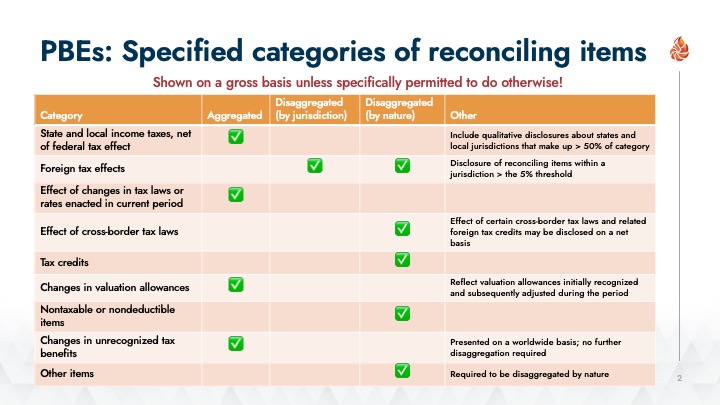
ASC 740 requires that for each annual reporting period a PBE “shall disclose” a tabular reconciliation, using both percentages and reporting currency amounts, the following eight categories of reconciling items:
- State and local income tax, net of federal (national) income tax effect
- Foreign tax effects
- Effect of changes in tax laws and rates enacted in the current period
- Effect of cross-border tax laws
- Tax credits
- Changes in valuation allowances
- Nontaxable or nondeductible items
- Changes in unrecognized tax benefits
If you don’t know accounting or auditing standards, which are too formal in my opinion, “shall” means “must!” In fact, the “Summary” section of ASU 2023-09 it states that these categories “are required to be disclosed.” More on this later!
Do PBEs need to further breakout any of these eight categories?
Yes. As depicted in the image above, separate disclosure is required for any reconciling item listed below in which the effect of the reconciling item is equal to or greater than 5 percent of the amount computed by multiplying the income (or loss) from continuing operations before income taxes by the applicable statutory income tax rate. For a company using the 21% U.S. federal statutory tax rate, the 5% threshold equates to a reconciling item affecting the effective tax rate by 1.05 percentage points (5% x 21%). These separate disclosures are:
- If the reconciling item is within the effect of cross-border tax laws, tax credits, or nontaxable or nondeductible items categories, it is required to be disaggregated by nature.
- If the reconciling item is within the foreign tax effects category, it is required to be disaggregated by jurisdiction (country) and by nature, except for reconciling items related to changes in unrecognized tax benefits.
- If the reconciling item does not fall within any of the specified categories, it is required to be disaggregated by nature.
Are these reconciling items presented gross or net?
Generally, these reconciling items are presented on a gross basis. However, the following reconciling items may be presented on a net basis:
- Unrecognized tax benefits and the related tax positions; and
- Effects of certain cross-border tax laws and the related tax credits.
Implementation of ASU 2023-09: Shine bright like a Dimon!
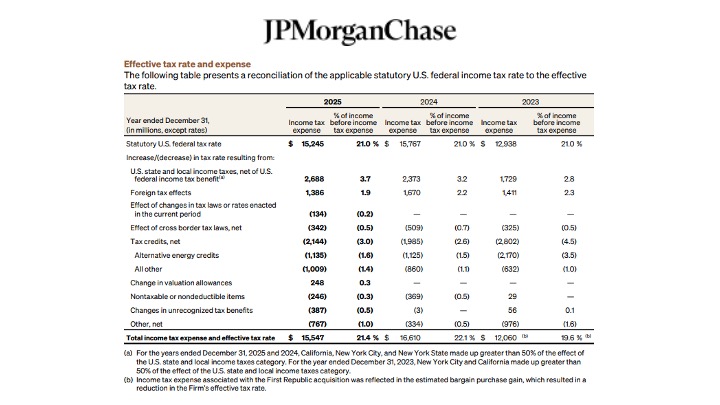
JPMorgan Chase had assets of $4.4 trillion and net income of $57 billion. Its auditors are PwC.
JPMorgan adopted ASU 2023-09 retrospectively, disclosing the new required tax rate reconciliation for all periods presented.
Of the eight “required” specified categories, JPMorgan discloses ALL EIGHT:
- State and local income taxes
- Foreign tax effects
- Effect of changes in tax laws or rates enacted during the current period
- Effect of cross-border tax laws
- Tax credits
- Changes in valuation allowance
- Nontaxable or nondeductible items
- Changes in unrecognized tax benefits
And, as you can see, they further broke out certain categories, either by nature or by jurisdiction if they were over the 5% threshold as required by ASU 2023-09.
Cue Montell Jordan because “This is how you do it!”
Do you have to disclose the specified categories set out in ASU 2023-09 if the effect is immaterial?
Good question! And here’s where things get interesting.
ASC 105-10-05-6 states that “the provisions of the Codification need not be applied to immaterial items.” So, yes, materiality still matters.
However, ASU 2023-09 specifically identifies eight categories that PBEs are required to disclose in their annual tax rate reconciliations. The FASB also established a 5% threshold for further disaggregation of certain reconciling items. Importantly, that 5% threshold applies to further disaggregation, not whether the eight specified categories should initially be presented.
So, here’s the question: At what point does aggregating individually small reconciling items into “Other” undermine the increased transparency that ASU 2023-09 was intended to provide?
JPMorgan Chase took an expansive approach, separately presenting all eight categories, including some with relatively small effects on its effective tax rate. Other companies have taken a different approach, applying materiality judgments to determine which categories warrant a separate presentation. While reasonable people may disagree about how materiality applies, we believe the FASB’s emphasis on specified categories deserves careful consideration before those categories are buried in “Other.”
Now let’s see what Nvidia did!
Implementation of ASU 2023-09 gone Huang!
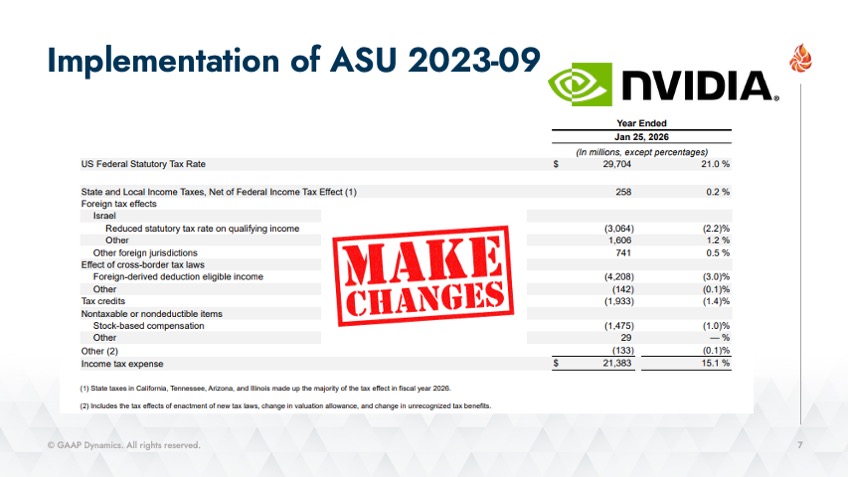
Nvidia had assets of $206 billion and net income of $120 billion. Its auditors are PwC.
Nvidia adopted ASU 2023-09 prospectively, only disclosing the required tax rate reconciliation in the current year (tax rate reconciliations for prior years not included).
Of the eight required categories, Nvidia only disclosed the following FIVE:
- State and local income taxes
- Foreign tax effects
- Effect of cross-border tax laws
- Tax credits
- Nontaxable or nondeductible items
The three other “required” specified categories that are lumped into “other” include:
- Effect of changes in tax laws or rates enacted in the current period
- Changes in valuation allowances
- Changes in unrecognized tax benefits
Are these undisclosed categories immaterial to Nvidia?
While in aggregate these line items appear to be immaterial (only changes the tax rate by -0.1%), what about individually?
Looking at Note 13 Income Taxes for the year ended January 25, 2026, Nvidia makes the following disclosures:
In July 2025, the OBBBA was enacted into law and contains several changes to key U.S. federal income tax laws. We have recognized the tax effects of currently effective OBBBA provisions in our results for fiscal years 2026.”
Note that Nvidia did not quantify the impact, which is strange because it quantified the other two required categories that it lumped into “Other.”
As of January 25, 2026 and January 26, 2025, we had a valuation allowance of $768 million and $1.6 billion, respectively, related to capital loss carryforwards, and certain other deferred tax assets that management determined are not likely to be realized due, in part, to jurisdictional projections of future taxable income, including capital gains. To the extent realization of the deferred tax assets becomes more-likely-than-not, we would recognize such deferred tax assets as income tax benefits during the period. As of January 25, 2026, based on recent jurisdictional taxable income and expected future earnings, we concluded certain state deferred tax assets are more likely than not realizable and released $711 million of valuation allowance.”
So, the valuation allowance changed by $711 million, a release to income, and it didn’t impact their tax rate enough to be disclosed even though it was a required category?
The balance of gross unrecognized tax benefits at January 26, 2025 was $2.86 billion. At January 25, 2026, the balance of gross unrecognized tax benefits was $4.42 billion. Included in the balance of unrecognized tax benefits as of January 25, 2026 are $3.7 billion of tax benefits that would affect our effective tax rate if recognized.”
Nvidia’s gross unrecognized tax benefits increased from $2.86 billion to $4.42 billion during fiscal year 2026, a net increase of approximately $1.56 billion. However, the change in the gross balance does not necessarily represent the impact on income tax expense or the effective tax rate. Determining the appropriate amount for the rate reconciliation requires analyzing the underlying changes and identifying those that affected the current year’s income tax expense.
Nevertheless, given the magnitude of the changes in Nvidia’s uncertain tax positions, we believe the absence of a separately presented “Changes in unrecognized tax benefits” category raises a reasonable question about how Nvidia applied the new disclosure requirements.
Interesting that Nvidia separately disclosed $258 million of state and local income taxes yet did not separately present changes in valuation allowances or unrecognized tax benefits, despite reporting significant activity in both areas elsewhere in its income tax footnote. Granted, these amounts do not necessarily represent their impact on the effective tax rate, but their magnitude certain raises questions worth exploring!
Implementation of ASU 2023-09 by non-PBEs
Non-PBEs are not required to provide a tabular tax rate reconciliation. However, ASU 2023-09 does require them to qualitatively disclose the nature and effect of significant differences by category. But let’s be honest. Their auditors are still required to audit this disclosure, even though it only contains words. As such, I would expect companies would have to crank out the tax rate reconciliation with amounts so their auditors can audit the disclosure.
Other required disclosures
Although the changes to the tax rate reconciliation is the “headline” change, for PBEs at least, ASU 2023-09 also requires additional income tax disclosures.
Income taxes paid (net of refunds received)
All entities are required to disclose income taxes paid (net of refunds received) for each annual period presented, disaggregated by domestic federal, domestic state, and foreign. Further disaggregation is required when the income taxes paid (net of refunds) to an individual jurisdiction is 5% or more of the total income taxes paid (net of refunds). For this purpose, each domestic or foreign federal or state jurisdiction is considered an individual jurisdiction.
Other income statement information about taxes
All entities are required under the ASU to disclose the following amounts for each annual reporting period presented:
- Pretax income (loss) from continuing operations, broken out between domestic and foreign; and
- Income tax expense (benefit) from continuing operations, broken out between domestic federal, domestic state, and foreign.
Concluding thoughts
In my opinion, JPMorgan Chase provides an excellent example of how to implement the new tax rate reconciliation requirements of ASU 2023-09. Its presentation includes all eight specified categories and gives financial statement users greater insight into the factors affecting its effective tax rate.
Nvidia? Well, let’s just say I think there’s room for improvement!
I was recently teaching this topic to professionals at a publicly traded company and got into a spirited debate with one of their accounting policy folks. His position was that Nvidia’s omitted categories were immaterial and therefore didn’t require separate presentation.
Fair enough. Materiality matters. But I would argue that the FASB didn’t specifically identify eight categories just so companies could lump some of them into “Other” without carefully considering the purpose of the new disclosure requirements.
So, who’s right? Or perhaps I should say, who’s Huang?
I’ll leave that for you to decide. But one thing’s for certain: Nvidia has learned the hard way that some things are definitely material – including having extramarital affairs with subordinates and a woman suspected of being a Chinese spy!
If you need help navigating the requirements of ASC 740, check out our Income Taxes Topic Page or our ASC 740: Accounting for Income Taxes course collection (4.5 CPE). Or just give us a call, we’d love to geek out with you and talk taxes!
About GAAP Dynamics
We’re a DIFFERENT type of accounting training firm. We view training as an opportunity to empower professionals to make informed decisions at the right time. Whether it’s U.S. GAAP, IFRS, or audit training, we’ve trained thousands of professionals since 2001, including at some of the world’s largest firms. Our promise: Accurate, relevant, engaging, and fun training. Want to know how GAAP Dynamics can help you? Let’s talk!
Disclaimer
This post is for informational purposes only and should not be relied upon as official accounting guidance. While we’ve ensured accuracy as of the publishing date, standards evolve. Please consult a professional for specific advice.

