

Auditing Fraud Risk: Evaluation of Significant Unusual Transactions
Quick, think of some of the most famous accounting failures in history. Enron, Worldcom, and, more recently, FTX, were likely on your list. Do you know what all these accounting failures had in common? Well, fraud, but more specifically, fraud that should have been uncovered by auditors performing a proper evaluation of significant unusual transactions. In Enron’s case, it was significant transactions with special purpose entities (SPEs). For WorldCom, it was unusual transactions labeled “prepaid capacity” that the head of internal audit had never seen before. With FTX, it was significant usual transactions with Alameda Research, a related party headed up by SBF’s lover. Red flags anyone?
We’ve previously discussed the requirements related to journal entry testing and reviewing management estimates for bias. In this post, we’ll discuss the requirement for auditors to evaluate the business purpose for significant unusual transactions to determine whether they were entered into to engage in fraud.
Are auditors required to test for fraud?
Yes. Auditors are required to test for fraud. However, it’s not as easy as it sounds. This is because management can override internal controls and to record fraudulent entries. As a result, AS 2401 Consideration of Fraud in a Financial Statement Audit (AS 2410) and AU-C 240 for U.S. GAAS audits require auditors to:
- examine journal entries,
- review accounting estimates for biases, and
- evaluate the business purpose for significant unusual transactions.
What is a significant unusual transaction?
AS 2401 defines significant unusual transactions as “significant transactions that are outside the normal course of business for the company or that otherwise appear to be unusual due to their timing, size, or nature.” Such transactions may be used by management to engage in fraudulent financial reporting or conceal the misappropriation of assets. So, what do the terms “significant” and “unusual” mean?
Significant
Interestingly, the term “significant” is not defined in any of the PCAOB auditing standards. However, the term is used within many standards such as:
- Significant deficiencies
- Significant accounts and disclosures
- Significant risks
- Significant matters
Certainly, if something is significant, it is important enough to warrant the auditor’s attention, which could significantly impact the financial statements.
Unusual
What is unusual for one company might be routine for another. In other words, whether something is unusual is entity specific. For example, take a securitization transaction involving selling residential mortgages to an offshore variable interest entity. For a large, national bank such a transaction might be commonplace. However, for a small community bank not so much and, therefore, it would be considered a significant unusual transaction.
Whether something is significant and/or unusual is a matter of professional judgment.
What are some examples of significant unusual transactions?
Many significant unusual transactions involve related parties, so we should start are search for significant unusual transactions there. Other examples of significant unusual transactions include:
- Transactions with non-market pricing and/or unusual terms
- Transactions lacking commercial substance
- Transactions involving complex structures
- Interest-free loans or loans that are uncollateralized
- Bill-and-hold transactions
- Sales that involve subsequent repurchase agreements
- Large, infrequent transactions made near period end
- Transactions that are subsequent reversed after the period
- Invoices and or journal entries with vague descriptions and/or misleading explanations from management
How do auditors find significant unusual transactions?
The starting point would be the risk assessment procedures performed in accordance with AS 2110 Identifying and Assessing Risks of Material Misstatement, which include:
- inquiring of management and others
- obtaining an understanding of the methods used to account for significant unusual transactions, and
- obtaining an understanding of internal control over financial reporting.
Other audit procedures performed throughout the audit might also uncover significant unusual transactions. These other procedures might include:
- Reading the minutes of the board of directors and other meetings
- Performing analytical procedures
- Conducting journal entry testing
Finally, the audit procedures we perform with respect to related parties might uncover significant unusual transactions. Appendix A of AS 2410 Related Parties provides examples of information that may be gathered during the audit that could indicate that related parties or relationships or transactions with related parties previously undisclosed to the auditor might exist.
What are the requirements of auditors once a significant unusual transaction is identified?
Auditors must evaluate whether significant unusual transactions that have been identified during the audit are properly accounted for and disclosed in the financial statements. However, it doesn’t stop there. Auditors must also evaluate whether the business purpose (or lack thereof) indicates that the significant unusual transaction may have been entered into to engage in fraud – either fraudulent financial reporting or misappropriation of assets.
Paragraph 66A of AS 2401 lists out the following procedures auditors should perform to obtain an understanding of the business purpose (or lack thereof) of each significant unusual transaction the auditor has identified.
- Read the underlying documentation
- Evaluate whether the terms and other information about the transaction are consistent with inquiries and other audit evidence
- Determine whether the transaction has been authorized and approved
- Evaluate the financial capability of the other parties
- Perform other procedures as necessary
Auditors might also consider confirming with the counterparty those terms of the transaction that are associated with a significant risk of material misstatement, including a fraud risk.
What are the indicators that a significant unusual transaction may have been entered into perpetuate fraud?
Paragraph 67 of AS 2401 provides the following listing of indicators:
- The form of the transaction is overly complex
- The transaction involves unconsolidated related parties, including variable interest entities (VIEs)
- The transaction involves related parties or relationships or transactions with related parties previously undisclosed to the auditor
- The transaction involves other parties that do not appear to have the financial capability to support the transaction without assistance from the entity
- The transaction lacks commercial or economic substance
- The transaction, while not with a related party, is not entered into at arm’s length
- The transaction enables the company to achieve certain financial targets
- Management places more emphasis on the accounting treatment rather than the economic substance of the transaction
- Management has discussed the nature of and accounting for the transaction with the audit committee and others
Practical example: Evaluating the business purpose of significant unusual transactions
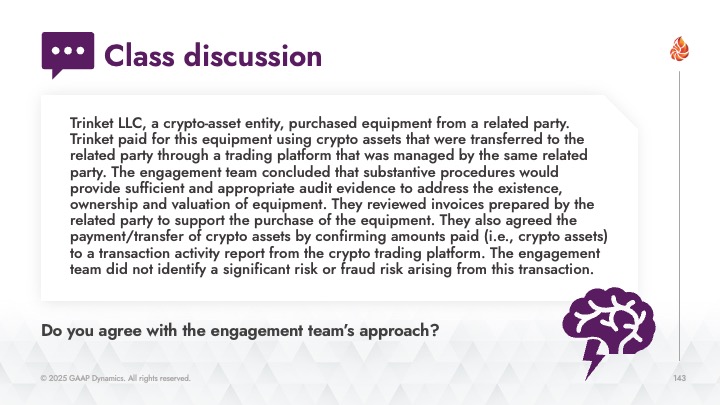
The following is a class discussion we use to illustrate the auditor requirement to evaluate the business purpose of significant unusual transactions in our classes:
Practical example
Debrief of practical example
No. The engagement team’s approach was not proper.
The engagement team did not evaluate if there was a reasonable business rationale for the transaction or consider if it had been entered into to engage in fraudulent financial reporting and/or to conceal a misappropriation of assets. The risk assessment was not adequately performed as the engagement team did not identify a risk of material misstatement that may exist when purchasing assets from a related party.
In addition, the specific assertion-level risks relating to the existence, ownership and valuation of the assets were not appropriately assessed. For example, the engagement team did not consider whether the amount paid for the equipment acquired and crypto assets transferred was reflective of the transaction’s fair value.
As a result, the audit evidence obtained was not sufficient to address the risks of material misstatement associated with this transaction.
Concluding thoughts
Auditing significant unusual transactions, including understanding their business purpose, is one of the most important things auditors do during an audit. Doing so correctly might just help you uncover the next Enron!
Are you doing all you can do to identify fraud in your financial statement audits? If not, we can help! Check out our online, CPE-eligible course, Consideration of Fraud (1.0 CPE), or let’s chat about a tailored, audit training for your firm.
About GAAP Dynamics
We’re a DIFFERENT type of accounting training firm. We view training as an opportunity to empower professionals to make informed decisions at the right time. Whether it’s U.S. GAAP, IFRS, or audit training, we’ve trained thousands of professionals since 2001, including at some of the world’s largest firms. Our promise: Accurate, relevant, engaging, and fun training. Want to know how GAAP Dynamics can help you? Let’s talk!
Disclaimer
This post is for informational purposes only and should not be relied upon as official accounting guidance. While we’ve ensured accuracy as of the publishing date, standard evolve. Please consult a professional for specific advice.

