

Auditing Fraud Risk: Review of Accounting Estimates for Bias
Management is responsible for the preparation of financial statements. This process includes making judgments or assumptions as it relates to accounting estimates. They are also responsible for monitoring the reasonableness of accounting estimates on an ongoing basis. However, management is also in a unique position to perpetrate fraud because of their ability to override controls. To mitigate this risk, auditing standards require auditors to perform certain procedures when auditing fraud risk. We’ve previously discussed the requirements related to journal entry testing. In this post, we’ll discuss the requirement for auditors to review accounting estimates for bias that could result in a material misstatement due to fraud.
Are auditors required to test for fraud?
Yes. Auditors are required to obtain sufficient appropriate audit evidence to obtain reasonable assurance about whether the financial statements are free from material misstatement. This requirement applies whether the misstatement was unintentional (error) or intentional (fraud).
However, detecting fraud is not easy. This is because management can manipulate accounting records by overriding established controls. As a result, AS 2401 Consideration of Fraud in a Financial Statement Audit (AS 2410) and AU-C 240 for U.S. GAAS audits require auditors to:
- examine journal entries,
- review accounting estimates for biases, and
- evaluate the business purpose for significant unusual transactions.
Is fraud risk considered a significant risk and what impact does this have on our audit?
Yes. AS 2110.71(b) states that a fraud risk is a significant risk. A significant risk requires “special audit consideration” because of the nature of the risk or the likelihood and potential magnitude of misstatement related to the risk. In other words, a significant risk requires a strong audit response in the form of extended audit procedures and obtaining more persuasive audit evidence.
For accounting estimates, this would mean obtaining better audit evidence related to the judgments and assumptions used by management that have the biggest impact! How do you find the most significant judgments and assumptions? Auditors should perform a sensitivity analysis, which demonstrates the degree to which a measurement varies based on one or more assumptions used in making the accounting estimate.
In addition, the engagement team should identify and test the operating effectiveness of the related controls over accounting estimates. According to AU Section 342 Auditing Accounting Estimates (since superseded by AU-C Section 540), specific relevant aspects of internal control include the following:
- Management communication of the need for proper accounting estimates
- Accumulation of relevant, sufficient, and reliable data on which to base an accounting estimate
- Preparation of the accounting estimate by qualified personnel
- Adequate review and approval of the accounting estimates by appropriate levels of authority including:
- Review of sources of relevant factors
- Review of development of assumptions
- Review of reasonableness of assumptions and resulting estimates
- Consideration of the need to use the work of specialists
- Consideration of changes in previously established methods to arrive at accounting estimates
- Comparison of prior accounting estimates with subsequent results to assess the reliability of the process used to develop estimates (i.e., perform a “look-back” analysis)
- Consideration by management of whether the resulting accounting estimate is consistent with the operational plans of the entity
Finally, since fraud is a significant risk, you’d expect increased partner involvement with respect to the audit procedure surrounding accounting estimates!

What are accounting estimates and can you give me some examples?
According to SAS 143 Auditing Accounting Estimates and Related Disclosures (codified in AU-C Section 540), an accounting estimate is a monetary amount for which the measurement, in accordance with the requirements of the applicable financial reporting framework, is subject to estimation uncertainty. Estimation uncertainty is susceptibility to an inherent lack of precision in measurement.
Historical financial statements include accounting estimates because:
- The measurement of some amounts or the valuations of some accounts is uncertain pending the outcome of future events.
- Relevant data concerning events that have already occurred cannot be accumulated on a timely, cost-effective basis.
Accounting estimates are an essential part of financial statements. Examples of accounting estimates include:
- Net realizable value (NRV) of inventory
- Recoverable amount and/or fair value of a long-lived asset tested for impairment
- Fair value of a reporting unit when testing goodwill for impairment
- Valuation of an investment without a readily determinable fair value (e.g., level 3)
- Warranty obligations
- Current expected credit losses (CECL) related to loans and other receivables
- Property and casualty (P&C) loss reserves
- Fair value of mortgage servicing rights (MSRs)
What responsibilities does management have with respect to accounting estimates?
As previously stated, management is responsible for making the accounting estimates included in the financial statements. These estimates include both objective and subjective factors. As a result, judgment is required to estimate an amount at the end of the reporting period. Management’s judgment is normally based on its knowledge and experience about past and current events and its assumptions about conditions it expects to exist and courses of actions it expects to take.
Management is responsible for establishing a process (and related controls) for preparing accounting estimates. Although the level of documentation may vary, the process normally consists of (per AU Section 342 Auditing Accounting Estimates):
- Identifying situations where accounting estimates may be required.
- Identifying the relevant factors that may affect the accounting estimate.
- Accumulating the relevant, sufficient, and reliable data on which to base the estimate.
- Developing assumptions that represent management’s judgment of the most likely circumstances and events with respect to the relevant factors.
- Determining the estimated amount based on the assumptions and other relevant factors.
- Determining that the accounting estimate is presented in conformity with applicable accounting principles and that disclosure is adequate.
Why do auditors review accounting estimates for bias?
AU Section 324 states “the risk of material misstatement of accounting estimates normally varies with the complexity and subjectivity associated with the process, the availability and reliability of relevant data, the number and significance of assumptions that are made, and the degree of uncertainty associated with the assumptions.”
According to the PCAOB’s Audit Focus: Auditing Accounting Estimates:
“By their nature, accounting estimates, including fair value measurements, generally involve subjective judgments and measurement uncertainty, making them to susceptible to management bias. Some estimates involve complex processes and methods. As a result, accounting estimates are often some of the areas of greatest risk in an audit, requiring additional audit attention and appropriate application of professional skepticism.”
This makes complete sense. As an auditor of financial institutions, I was laser-focused on the allowance for credit losses (ACL) and, if applicable, the valuation of mortgage servicing rights (MSRs). For my insurance clients, it was level of insurance reserves, specifically the incurred, but not report (IBNR) reserve. It’s where the “action” was, the whole kit and kaboodle of our audit. Why? Because it was in these areas where, if they wanted to, management could manipulate the results!
What are the requirements within auditing standards for review of accounting estimates for bias?
Management can perpetrate fraud through the intentional misstatement of accounting estimates. As such, AS 2810 Evaluating Audit Results (AS 2810) requires “the auditor should evaluate whether the difference between estimates best supported by the audit evidence and estimates included in the financial statements, which are individually reasonable, indicate a possible bias on the part of the company’s management.”
Example 1: Potential management bias in accounting estimates (taken from AS 2810)
If each accounting estimate included in the financial statements was individually reasonable but the effect of the difference between each estimate and the estimate best supported by the audit evidence was to increase earnings or loss, the auditor should evaluate whether these circumstances indicate potential management bias in the estimates.
Example 2: Potential management bias in accounting estimates (taken from AS 2810)
Bias can also result from the cumulative effect of changes in multiple accounting estimates. If the estimates in the financial statements are grouped at one end of the range of reasonable estimates in the prior year and are grouped at the other end of the range of reasonable estimates in the current year, the auditor should evaluate whether management is using swings in estimates to achieve a desired outcome (e.g., to offset higher or lower than expected earnings).
Requirement to perform a retrospective review
AS 2401 requires auditors to perform a retrospective review of accounting estimates in significant accounts and disclosures for which there is an assessed fraud risk. We do this by comparing prior year’s estimates to actual results to determine whether management’s judgments and assumptions relating to estimates indicate a possible bias on the part of management. According to AS 2401, “with the benefit of hindsight, a retrospective review should provide the auditor with additional information about whether there may be a possible bias on the part of management in making current-year estimates.”
What are the requirements if we identify a possible bias in an accounting estimate?
If an auditor identifies a possible bias, they should evaluate whether circumstances producing such a bias represent a material misstatement due to fraud. How do we do this? Well, AS 2401 provides the following example:
“For example, information coming to the auditor’s attention may indicate a risk that adjustments to the current-year estimates might be recorded at the instruction of management to arbitrarily achieve a specified earnings target.”
The mere presence of management bias does not always indicate fraud. However, according to SAS 143, “when there is an intention to mislead, management bias is fraudulent in nature.”
Practical example: Reviewing accounting estimates for bias
The following is a class discussion we use to illustrate the impact of management bias on accounting estimates in our classes:
Practical example
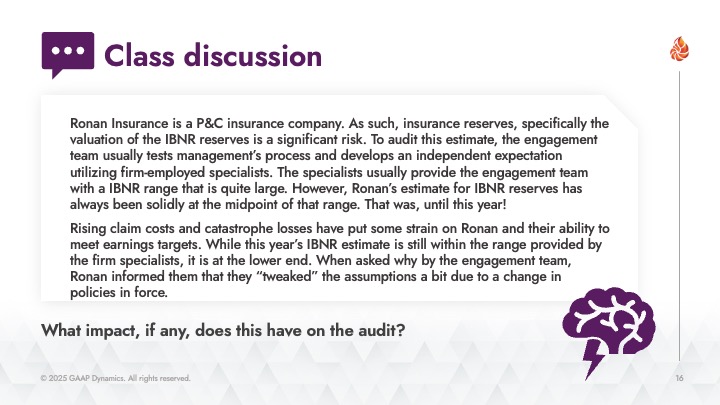
Debrief of practical example
The situation in the example clearly indicates a potential for management bias. As a result, the auditor should exercise professional skepticism and deal with it accordingly in the audit file.
According to AS 1000.11, the auditor’s exercise of professional skepticism includes:
- Objectively evaluating audit evidence obtained in an audit (including information that both supports management’s assertions and information that contradicts those assertions), and consideration of the sufficiency and the appropriateness (i.e., relevance and reliability) of that evidence.
- Remaining alert to conditions that may indicate possible misstatement due to error or fraud.
- Not being satisfied with evidence that is less than persuasive.
- Not assuming that management is honest or dishonest.
- Considering potential bias on the part of management and the auditor.
When indicators of management bias are identified, there may be a risk of material misstatement either at the assertion level or financial statement level. Indicators of possible management bias themselves do not constitute misstatements for purposes of drawing conclusions on the reasonableness of individual accounting estimates. However, in some cases the audit evidence may point to a misstatement rather than simply an indicator of management bias.
Indicators of potential management bias may affect the auditor’s conclusion as to whether the auditor’s risk assessment and related responses remain appropriate. In other words, we might need to reassess our risk assessment!
The auditor may need to consider the implications for other aspects of the audit, including the need to further question the appropriateness of management’s judgments in making accounting estimates. Further, indicators of possible management bias may affect the auditor’s conclusions as to whether the financial statements as a whole are free from material misstatement. Finally, we should evaluate whether management’s judgments and decisions in making accounting estimates indicate a possible bias that may represent a material misstatement due to fraud.
As a side note, the fact that the range provided by the Auditor-Engaged specialist is so wide, is probably also an issue!
Concluding thoughts
Using accounting estimates to “arbitrarily achieve” earnings targets and “intentionally mislead” investors is fraud. So, if your banking client is using the allowance for credit losses, or your insurance client is using their IBNR reserve, to manage earnings, that is fraud. Full stop. I kind of wish my 54-year-old self could go back in time with a fresh set of eyes to look at his audits of yesteryear armed with this newfound wisdom. A retrospective review as it were!
Are you doing all you can do to identify fraud in your financial statement audits? If not, we can help! Check out our online, CPE-eligible course, Consideration of Fraud (1.0 CPE), or let’s chat about a tailored, audit training for your firm.
About GAAP Dynamics
We’re a DIFFERENT type of accounting training firm. We view training as an opportunity to empower professionals to make informed decisions at the right time. Whether it’s U.S. GAAP, IFRS, or audit training, we’ve trained thousands of professionals since 2001, including at some of the world’s largest firms. Our promise: Accurate, relevant, engaging, and fun training. Want to know how GAAP Dynamics can help you? Let’s talk!
Disclaimer
This post is for informational purposes only and should not be relied upon as official accounting guidance. While we’ve ensured accuracy as of the publishing date, standard evolve. Please consult a professional for specific advice.

